 By Ahmad Bilal · November 24, 2026
It was one of those long days. Back-to-back lab sessions in the morning, a pile of reports to mark after lunch, and the evening feeding round at the rescue shelter. By the time I sat down with a cup of chai, it was close to ten at night, and there was a message waiting for me.
It was from Hamza, a Pakistani student doing his master’s at a university in Australia. He and two classmates, Mehak and Daniyal, had been given a question in their energy policy course that had them stuck: if Pakistan moved away from fossil fuels, which sectors would feel it first, and how badly? They didn’t want an answer handed to them. They wanted to understand how to think about it.
We got on a video call that same night. I opened a blank whiteboard and asked them one thing: “Before we talk about feelings, can we put numbers on it?” For the next hour we brainstormed. What does fossil fuel actually add to GDP? Who loses their job first, the miner in Thar or the engineer in Karachi? Is there a country that has already been through this?
After the call I couldn’t stop thinking about it. I stayed up well past two, turning our whiteboard scribbles into proper equations with real figures. What follows is the write-up I prepared for them, exactly as I wrote it that night.
The question they brought me
What would a shift away from fossil fuels do to Pakistan’s key sectors: its GDP, its mining industry and its workers?
3. Impact on Key Sectors
3.1 Economic Dependence on Fossil Fuels
Fossil fuels, especially coal, oil, and natural gas, are deeply integrated into Pakistan’s economy, contributing significantly to its GDP, export revenues, and employment. The equation below calculates the contribution of fossil fuels to Pakistan’s GDP:
GDP_{FF} = Σ (P_i × Q_i)
Where:
GDP_{FF} is the total GDP contribution from fossil fuels,
P_i is the price of each fossil fuel type,
Q_i is the quantity produced,
n is the number of fossil fuel types.
For Pakistan, we can estimate this contribution using the following data:
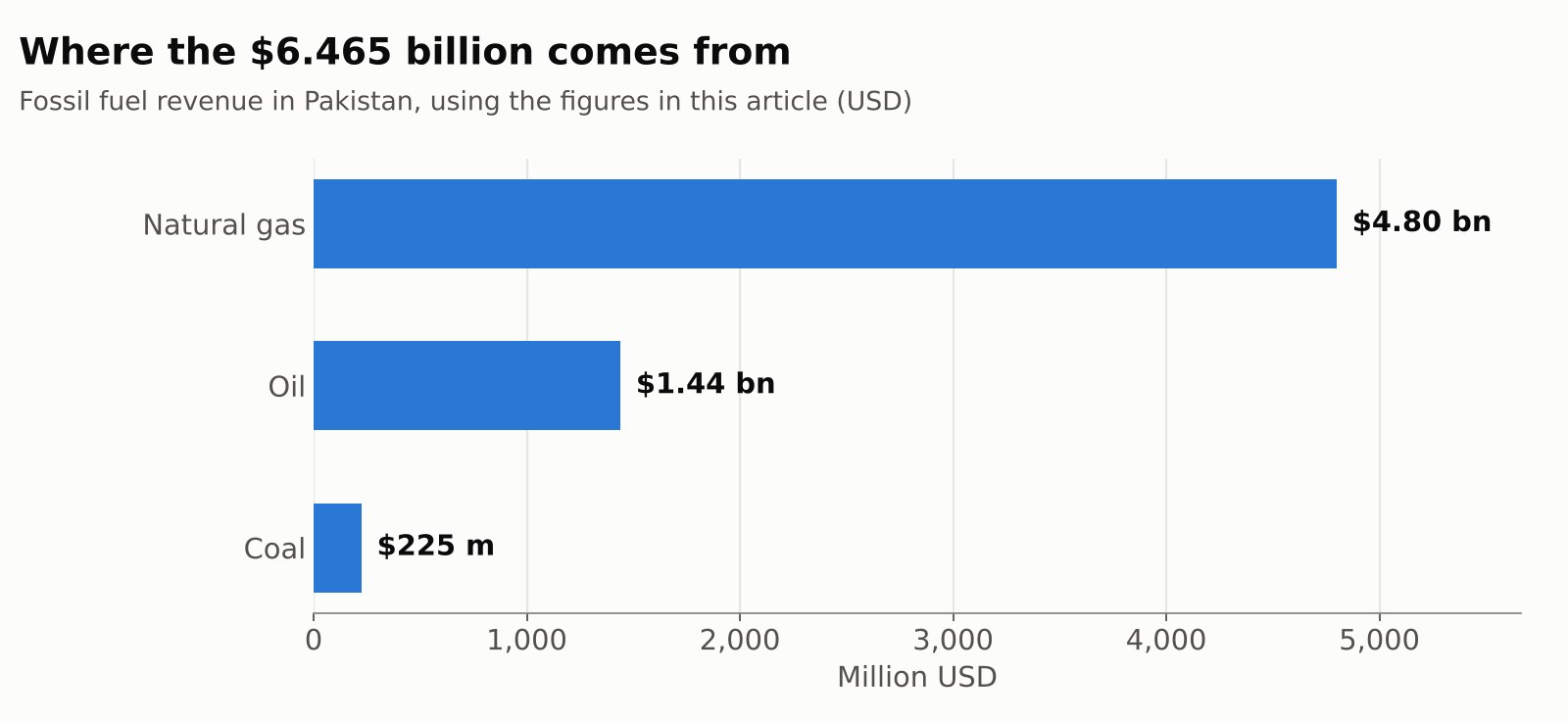
1. Coal Revenue:
Q_{coal} = 4.5 million tons,
P_{coal} = 50 USD per ton,
Total revenue = 4.5 × 50 = 225 million USD.
2. Natural Gas Revenue:
Q_{gas} = 1200 billion cubic feet,
P_{gas} = 4 USD per thousand cubic feet,
Total revenue = 1200 × 4 = 4800 million USD (or 4.8 billion USD).
3. Oil Revenue:
Q_{oil} = 24 million barrels,
P_{oil} = 60 USD per barrel,
Total revenue = 24 × 60 = 1440 million USD (or 1.44 billion USD).
Thus, the total GDP contribution from fossil fuels is calculated as:
GDP_{FF} = 225 million + 4.8 billion + 1.44 billion = 6.465 billion USD.
Impact on Pakistan: A sudden shift away from fossil fuels would result in a significant reduction in GDP, which could destabilize Pakistan’s already fragile economy. The reduction of $6.465 billion in GDP would lead to diminished government revenues, particularly from taxes and royalties associated with fossil fuel industries. Historically, countries such as Greece and Indonesia, which were forced to cut subsidies or transition away from key economic sectors, faced severe economic recessions. Similarly, a hasty transition could lead to unemployment and fiscal crises in Pakistan.
Lessons from abroad mentioned in this article
| Country | What happened | Lesson for Pakistan |
| Greece | Forced to cut subsidies and move away from key sectors; severe recession | Move gradually and protect public revenue |
| Indonesia | Subsidy cuts and transition shocks; severe recession | Plan the timing, not just the target |
| Zimbabwe | Land reform abruptly ended a key sector; unemployment and collapse in farm output | Build new industries before closing old ones |
| Sri Lanka | Sudden shift to organic farming; job losses and instability | Test big changes before going nationwide |
Fun fact
More than 40 per cent of Pakistan’s primary energy supply comes from imported crude oil, petroleum products, LNG and coal. That is why every global oil shock is felt at Pakistani petrol pumps within weeks.
3.2 Impact on the Mining Industry
The mining sector, particularly coal mining in regions like Tharparkar, plays a crucial role in Pakistan’s energy economy. The impact of reducing coal production can be captured by the following equation:
MSR = Q_{coal} × P_{coal} – C_{closure}
Where:
MSR is the mining sector revenue,
Q_{coal} is the quantity of coal mined,
P_{coal} is the price per ton,
C_{closure} represents the costs associated with mine closures and layoffs.
For Pakistan, with coal production generating $225 million in revenue and closure costs estimated at $100 million, the equation becomes:
MSR = 225 million – 100 million = 125 million USD.
Impact on Pakistan: This would result in a loss of $100 million and the displacement of thousands of miners, exacerbating unemployment. Zimbabwe’s land reform program, which abruptly ended a key economic sector, provides a parallel; it led to widespread unemployment and a collapse in agricultural output. Pakistan could face similar consequences if alternative industries are not developed alongside the transition.
Fun fact
The Thar desert in Sindh sits on an estimated 175 billion tonnes of coal, one of the largest lignite deposits in the world.
3.3 Structural Unemployment
The decline of fossil fuel industries is likely to result in structural unemployment, where workers’ skills no longer match the requirements of emerging industries such as renewable energy. The structural unemployment rate can be calculated as:
U_s = (E_{ff} – E_{re}) / L
Where:
U_s is the structural unemployment rate,
E_{ff} is employment in fossil fuel industries,
E_{re} is employment in renewable energy industries,
L is the total labor force.
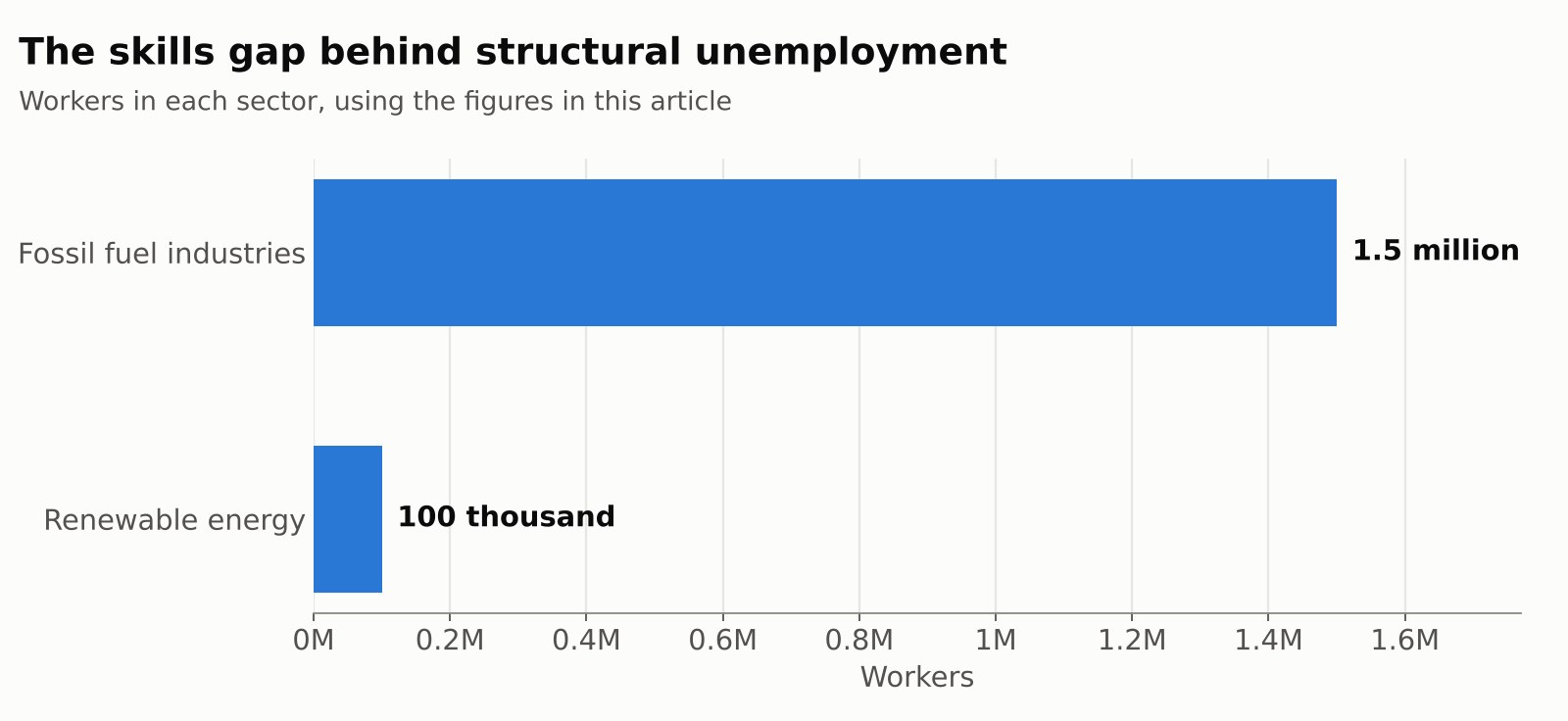
For Pakistan, with 1.5 million workers in fossil fuel industries, 100,000 workers in renewable energy, and a labor force of 65 million, the equation becomes:
U_s = (1,500,000 – 100,000) / 65,000,000 = 1,400,000 / 65,000,000 = 0.0215 or 2.15%.
Impact on Pakistan: A 2.15% rise in unemployment could lead to further social unrest, particularly in regions already experiencing high unemployment and economic deprivation. Sri Lanka’s shift to organic farming, which caused widespread job losses and economic instability, is a relevant comparison. Pakistan’s economy may face similar unrest if a rapid green energy transition displaces a significant portion of the workforce without adequate retraining and job creation in renewable energy sectors.
Try it yourself
Move the slider to see what different cuts would mean, using the same figures as the equations above.
Pakistan in 2026: the latest news
Since I wrote this, Pakistan has actually been leaning harder on its own coal, mainly to cut expensive imports:
Thar mine triples its output
Sindh Engro Coal Mining Company tripled its yearly capacity to 11.2 million tonnes by 30 September 2026, aiming to replace imported coal and save foreign exchange.
From diesel to grid power
In November 2026, work began on moving Thar mining from diesel to the national grid, which is expected to save around $25 to 30 million a year.
A railway for local coal
The federal and Sindh governments plan a rail link so that power plants built for imported coal can switch to Thar coal instead.
Fun fact
Thar Blocks I and II already generate about 2,640 megawatts of electricity, and four of Pakistan’s six cheapest power plants now run on Thar coal.
Sources for the news and fun facts
Daily Times, 16 November 2026: SECMC capacity rises to 11.2m tonnes. https://dailytimes.com.pk/?p=1581970
Daily Times, 19 November 2026: Thar coal mining to shift from diesel to grid power. https://dailytimes.com.pk/?p=1583552
The Express Tribune, 10 November 2026: Thar coal to replace imports. https://tribune.com.pk/story/2639491/thar-coal-to-replace-imports
The Express Tribune, 15 March 2026: Global shocks spark calls for Thar coal use. https://tribune.com.pk/story/2597678/global-shocks-spark-calls-for-thar-coal-use
Dawn, 1 March 2026: Sindh earns billions in royalties but Thar yet to be transformed. https://www.dawn.com/news/1976751
Dawn, 11 March 2026: Govt urged to raise Thar coal use amid volatile energy markets. https://www.dawn.com/news/amp/1980692