 By Ahmad Bilal · November 20, 2026
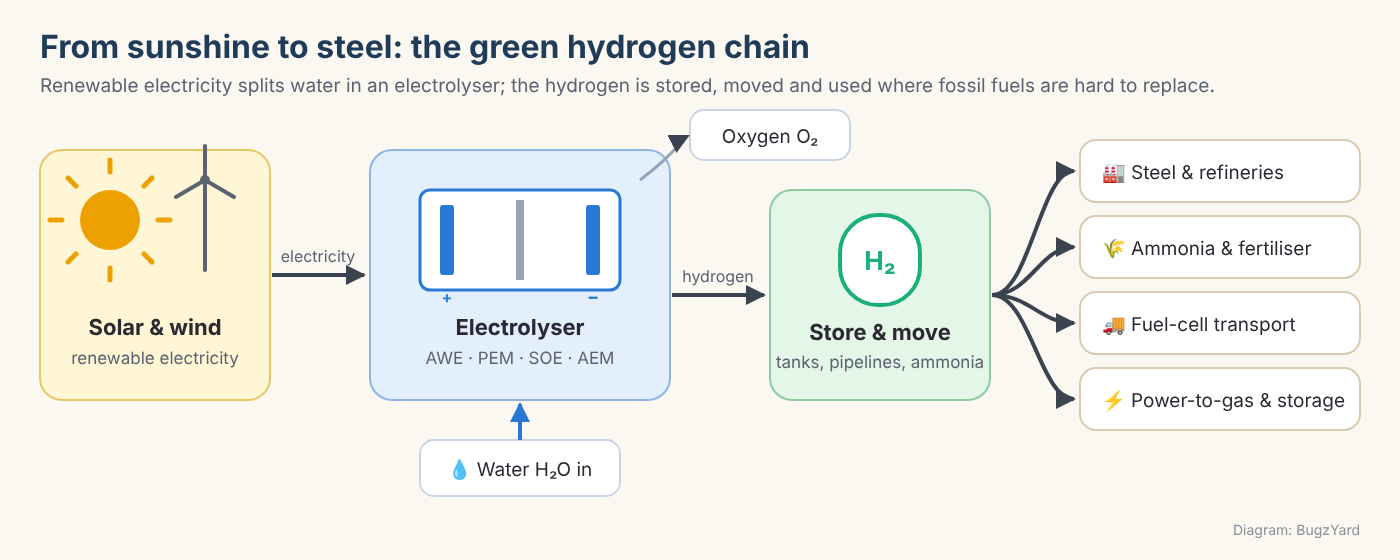
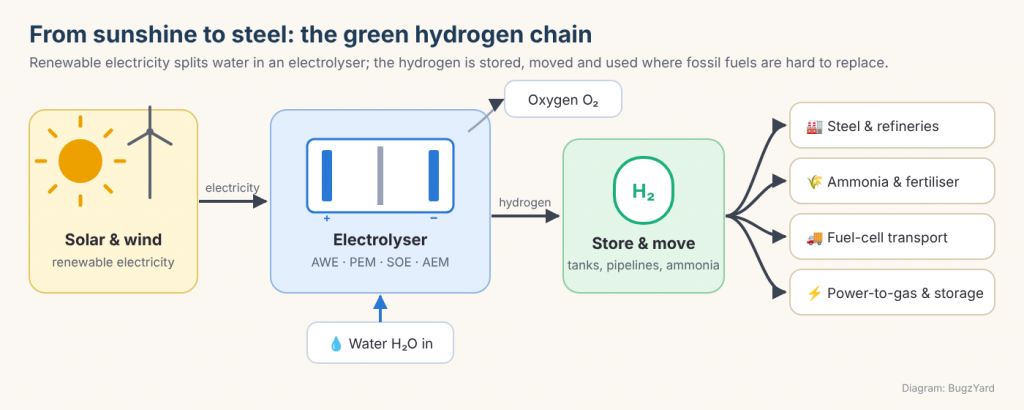
Green hydrogen has emerged as a pivotal component in the global effort to achieve net-zero emissions and facilitate a transition to a sustainable energy ecosystem. The production of green hydrogen, which is derived from renewable energy sources, has the potential to significantly reduce carbon emissions and facilitate the provision of clean energy across a range of sectors, including transportation, industry, and power generation. The production of green hydrogen is underpinned by the process of water electrolysis, which employs electricity to split water into hydrogen and oxygen. The necessity for the advancement of water electrolysis technology is driven by three key factors: the global shift towards decarbonisation, the rise in renewable energy generation, and the urgency of addressing climate change.
The production of green hydrogen is underpinned by the process of water electrolysis, which employs electricity to split water into hydrogen and oxygen.
It is imperative that human factors be incorporated into the development and deployment of water electrolysis technologies. The objective of human factors is to optimise the interaction between people, systems and technology, with the aim of enhancing efficiency, safety and usability. In the context of green hydrogen production, the incorporation of human factors considerations ensures that electrolysis systems are designed with user-friendly interfaces, accessible maintenance procedures, and enhanced operational safety. This not only encourages the uptake of the technology but also improves the efficiency of the hydrogen production process.
Why human factors matter
The incorporation of human factors into the development of water electrolysis technology offers a multitude of advantages. Firstly, the incorporation of human factors increases operational safety by reducing the risks of accidents, particularly in industrial environments. Secondly, user-friendly systems reduce the training time for operators, thus accelerating the implementation of green hydrogen technologies. Thirdly, human-centred design ensures that maintenance and troubleshooting are streamlined, minimising downtime and enhancing overall system reliability. By improving usability, human factors can ultimately contribute to lowering costs and enhancing the scalability of hydrogen production, making it a more viable solution for decarbonising industries worldwide.
a. Well-Known and Emerging Water Electrolysis Technologies
Water electrolysis technologies can be broadly classified into four categories:
Alkaline (AWE)
Temperature: 60–90 °C
Efficiency: 60–70%
Maturity: High
PEM
Temperature: 50–80 °C
Efficiency: 70–80%
Maturity: Moderate
Solid Oxide (SOE)
Temperature: 700–1000 °C
Efficiency: 85–90%
Maturity: Low
Anion Exchange (AEM)
Temperature: 30–60 °C
Efficiency: 60–70%
Maturity: Low
Alkaline Water Electrolysis (AWE)
Description:
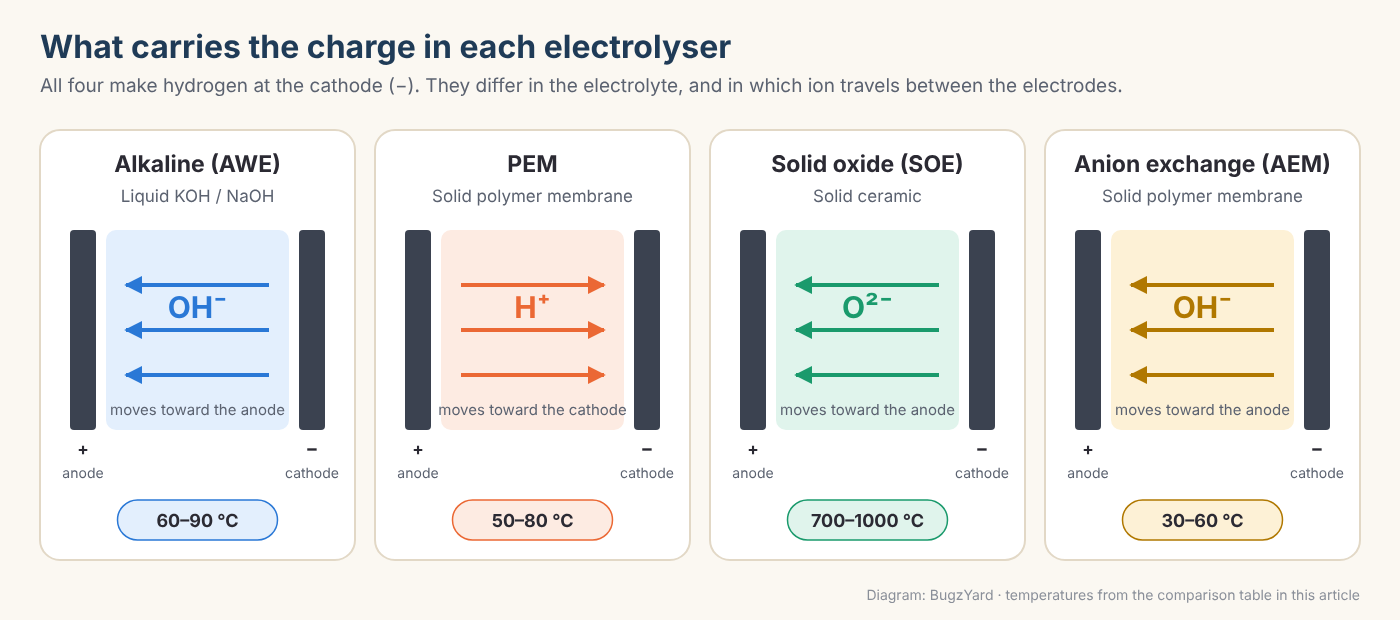
Alkaline water electrolysis is one of the oldest and most established methods for producing hydrogen. It uses a liquid alkaline electrolyte solution, typically potassium hydroxide (KOH) or sodium hydroxide (NaOH), and operates at low temperatures (60-90°C). The electrolyte solution facilitates ion transfer between the cathode and anode, where hydrogen and oxygen are produced.
Advantages:
- Mature technology with a low-cost catalyst (nickel-based)
- Operates at lower temperatures
- Higher lifespan and reliability
Disadvantages:
- Lower current density and efficiency compared to other methods
- Large cell volume, making it less suitable for compact applications
- Limited dynamic operation (ramp-up/down capabilities)
Applications:
Primarily used for industrial-scale hydrogen production and applications requiring stable, long-term production capabilities.
Proton Exchange Membrane (PEM) Electrolysis
Description:
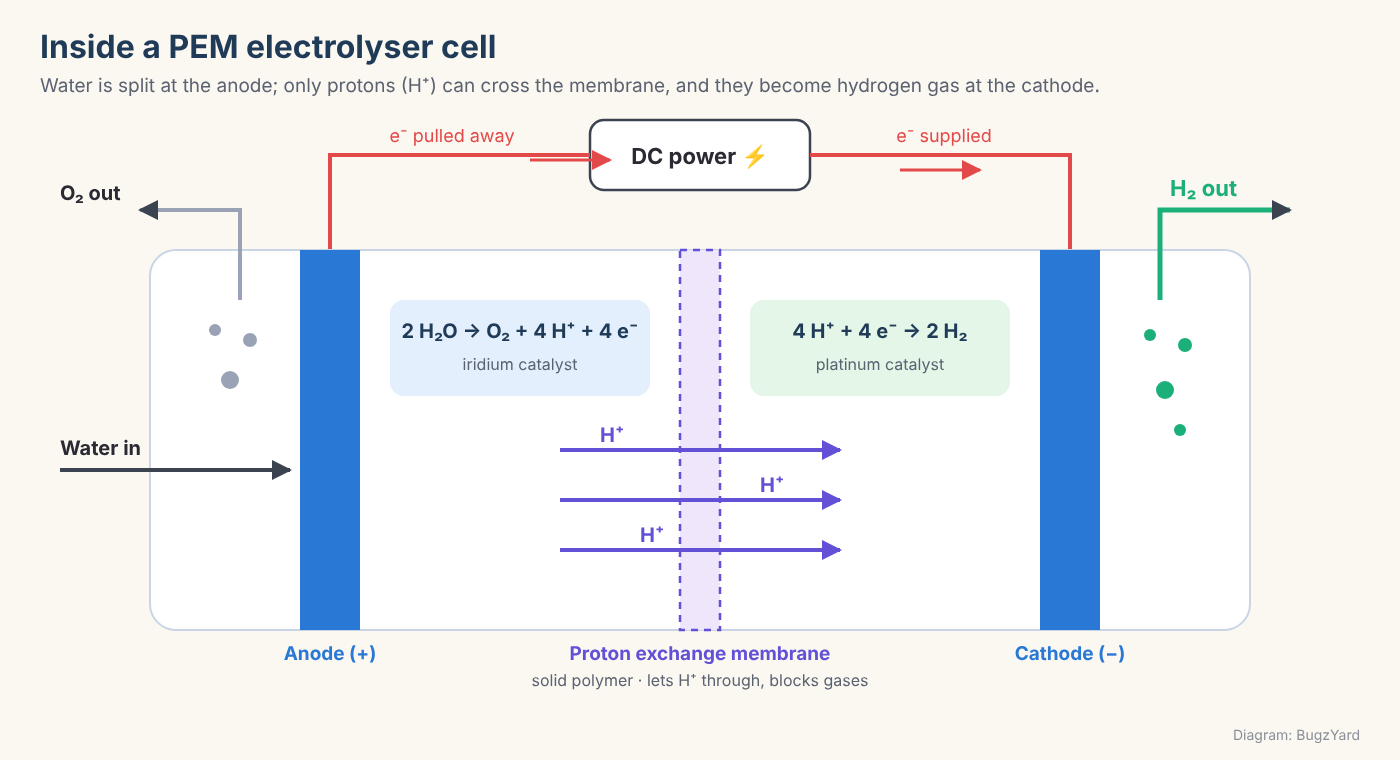
PEM electrolysis uses a solid polymer electrolyte that conducts protons and separates the hydrogen and oxygen gases. Operating at temperatures between 50-80°C, it offers high current density and efficiency. PEM electrolyzers can operate under dynamic conditions, making them suitable for coupling with renewable energy sources.
Advantages:
- High efficiency and fast response to power fluctuations
- Compact design and higher hydrogen purity
- Suitable for integration with renewable energy sources (wind, solar)
Disadvantages:
- Requires expensive noble metal catalysts (platinum, iridium)
- Higher capital costs
- Limited durability due to membrane degradation
Applications:
Ideal for applications requiring high-purity hydrogen, such as fuel cells and power-to-gas systems.
Solid Oxide Electrolysis (SOE)
Description:
Solid Oxide Electrolysis operates at high temperatures (700-1000°C) and utilizes a solid ceramic electrolyte that conducts oxygen ions. The high operating temperature allows the use of heat energy, reducing the need for electrical energy input and improving overall efficiency.
Advantages:
- High electrical efficiency due to combined heat and power usage
- Potential for co-electrolysis (producing syngas by simultaneously reducing CO2 and water)
Disadvantages:
- High operating temperature leads to material challenges and lower durability
- Longer start-up time and lower system flexibility
- High costs associated with high-temperature-resistant materials
Applications:
Suitable for industrial applications where waste heat is available, such as steel manufacturing, or for large-scale hydrogen production.
Anion Exchange Membrane (AEM) Electrolysis
Description:
AEM is an emerging technology that combines the advantages of both alkaline and PEM electrolysis. It uses a solid polymer membrane that allows hydroxide ions (OH-) to pass through, eliminating the need for a liquid electrolyte.
Advantages:
- Potentially lower costs due to non-precious metal catalysts
- Higher efficiency than AWE
- Can operate at lower temperatures
Disadvantages:
- Limited maturity and operational data
- Durability issues related to membrane stability
Applications:
Still in research and development stages, with potential applications in distributed hydrogen production and coupling with renewable energy sources.
b. Most Promising Electrolysis Technology
Based on current research and technological advancements, Proton Exchange Membrane (PEM) Electrolysis emerges as the most promising technology for green hydrogen production. The reasoning behind this selection includes:
- High Efficiency and Purity: PEM electrolyzers offer higher hydrogen production rates with superior purity compared to alkaline and solid oxide systems.
- Dynamic Response: Their ability to operate under dynamic conditions makes PEM ideal for integration with intermittent renewable energy sources, such as solar and wind power.
- Scalability and Flexibility: PEM systems are more compact and can be scaled for small to large applications, from fuel stations to industrial plants.
The challenge
However, the high cost of catalysts and membranes remains a challenge. Continued research into catalyst development, membrane durability, and system integration is crucial to reduce costs and enhance the overall viability of PEM technology.
Comparative Analysis
The following table presents a comparative analysis of the discussed water electrolysis technologies:
| Feature | Alkaline Water Electrolysis (AWE) | Proton Exchange Membrane (PEM) | Solid Oxide Electrolysis (SOE) | Anion Exchange Membrane (AEM) |
|---|---|---|---|---|
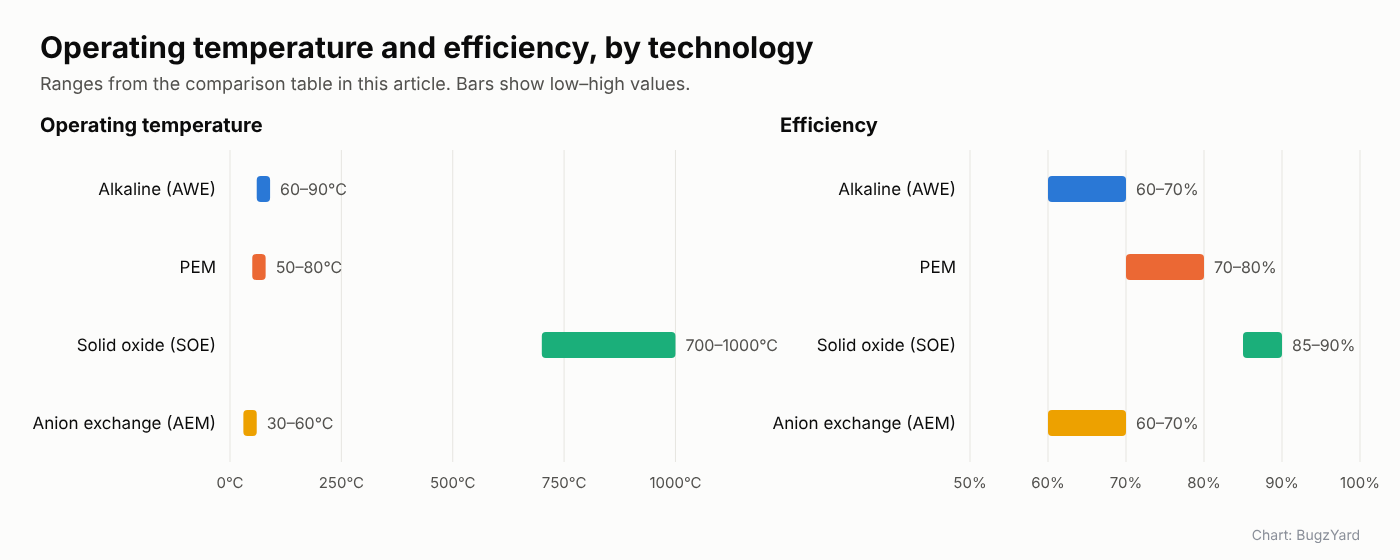
| Operating Temperature (°C) | 60-90 | 50-80 | 700-1000 | 30-60 |
| Electrolyte | Liquid KOH/NaOH | Solid Polymer | Solid Ceramic | Solid Polymer |
| Catalyst | Nickel-based | Platinum/Iridium | Perovskites | Nickel-based |
| Efficiency (%) | 60-70 | 70-80 | 85-90 | 60-70 |
| Hydrogen Purity | Moderate | High | High | High |
| Cost | Low | High | High | Moderate |
| Maturity | High | Moderate | Low | Low |
| Suitable for Renewable Energy | Low-Medium | High | Medium | High |
| Durability | High | Moderate | Low | Moderate |
Latest developments in 2026
The electrolyser market has moved quickly since this comparison was first written. Here is what happened this year, technology by technology.
The big picture
- Installed electrolysis capacity worldwide doubled in 2025 to more than 4 GW, with China behind nearly three-quarters of new installations; over 2.5 GW more is under construction for 2026 (IEA).
- Hydrogen investment could approach USD 10 billion in 2026, around 70% of it in electrolysis (IEA).
- Factories can now build about 58 GW of electrolysers a year, but fewer than 5 GW were made in 2025, so the industry is consolidating (IEA, reported by Argus).
- More than 100 GW of announced projects could miss 2030 unless investment decisions are taken by the end of 2027 (IEA).
PEM: scaling up
- Plug Power was chosen to supply a 275 MW PEM system for the Courant ammonium-nitrate project in Québec (April 2026).
- ITM Power delivered the first stacks for Shell’s 100 MW PEM plant in Rheinland, Germany (September 2026).
AEM: from lab to market
- Horizon delivered what it describes as the world’s first 5 MW AEM electrolyser to a working steel plant in Tianjin, China (April 2026).
- Power to Hydrogen installed a half-megawatt AEM unit at the Port of Antwerp-Bruges and finished a pilot of more than 1,250 hours with Repsol (2026).
Alkaline: still the workhorse
- Nel launched a next-generation pressurised alkaline system (May 2026).
- Finnish researchers reported raising the operating voltage of alkaline systems to cut costs by 10–15% (October 2026).
Big plants coming online
- Commissioning began at NEOM’s 2.2 GW green hydrogen and ammonia plant in Saudi Arabia (August 2026).
- Germany’s 30 MW Bad Lauchstädt plant produced its first green hydrogen (November 2026).
Solid oxide: maturity still matters
One US ammonia developer reportedly dropped a planned 100 MW solid oxide system in favour of more mature alkaline or PEM technology, to reduce execution risk. This matches the low maturity score for SOE in the table above.
Sources for this section
- IEA, Global Hydrogen Review 2026: Production
- IEA, Global Hydrogen Review 2026: Investment and innovation
- Argus: Green H2 electrolyser sector enters consolidation
- Plug Power selected for 275 MW Courant project (DecarbonFuse)
- ITM Power delivers first stacks for Refhyne 2 (H2-international)
- Horizon’s 5 MW AEM delivery to Rockcheck Steel (DecarbonFuse)
- Power to Hydrogen AEM electrolyser at the Port of Antwerp-Bruges
- Power to Hydrogen and Repsol AEM pilot (Hydrogen Central)
- Nel launches pressurised alkaline platform (Indian Chemical News)
- Finnish researchers raise alkaline voltage to cut costs (pv magazine)
- Commissioning begins at NEOM 2.2 GW project (pv magazine)
- Bad Lauchstädt Energy Park electrolysis up and running (H2-international)
- Electrolyser market review incl. First Ammonia (EnkiAI)
Conclusion and Way Forward
Water electrolysis is a cornerstone technology for green hydrogen production. Among the well-known and emerging electrolysis technologies, PEM electrolysis stands out due to its high efficiency, purity, and suitability for dynamic renewable energy integration. However, cost reduction and durability improvement are critical areas that require further research and development. As countries commit to decarbonization targets, continued investment in these technologies will be essential to realize the vision of a hydrogen-based economy.
Moving forward, advancements in materials science, system integration, and renewable energy coupling will play a pivotal role in optimizing water electrolysis systems. Collaborative efforts between academia, industry, and policymakers are essential to address the existing challenges and accelerate the deployment of green hydrogen technologies on a global scale.
References
- Barbir, F. (2020). PEM electrolysis for production of hydrogen from renewable energy sources. Solar Energy, 30(3), 345-352.
- Carmo, M., et al. (2013). A comprehensive review on PEM water electrolysis. Journal of Hydrogen Energy, 38(12), 4901-4934.
- IEA. (2022). The Future of Hydrogen. International Energy Agency Report.
- Zhang, Y., et al. (2018). Recent progress on solid oxide electrolysis for efficient hydrogen production. Journal of Energy Chemistry, 27(4), 993-1006.
Final recommendations
- Investment in R&D: Focus on PEM and AEM technologies to reduce catalyst costs and improve membrane durability.
- Industrial Implementation: Utilize AWE for large-scale, stable production needs and SOE for high-efficiency industrial processes where waste heat is available.
- Policy Support: Encourage public and private partnerships to accelerate technological advancements and scaling of emerging technologies like AEM.
These insights can aid stakeholders in making informed decisions for transitioning towards a hydrogen-based economy, achieving net-zero emissions, and promoting energy sustainability.
Conclusion
The global push towards green hydrogen production is motivated by the need to reduce greenhouse gas emissions and transition to a low-carbon economy. Investment in green hydrogen has seen an exponential rise over the past decade, and its impact on economic growth is already being observed in leading countries. By adopting advanced electrolysis technologies and increasing financial support for R&D, the vision of a hydrogen-based economy can be realized, providing a sustainable and economically viable solution for the future.
This comprehensive analysis, supported by charts and graphs, offers valuable insights for stakeholders aiming to navigate the evolving landscape of green hydrogen production.
Comprehensive Analysis of Water Electrolysis Technologies for Green Hydrogen Production: Economic and Environmental Impacts
Introduction
The transition to a hydrogen-based economy is pivotal for addressing global energy sustainability and mitigating climate change impacts. As countries strive to achieve net-zero emissions and reduce reliance on fossil fuels, green hydrogen, produced through water electrolysis, has emerged as a promising solution. This essay offers a comprehensive evaluation of well-known and emerging water electrolysis technologies, such as Alkaline Water Electrolysis (AWE), Proton Exchange Membrane (PEM) Electrolysis, Solid Oxide Electrolysis (SOE), and Anion Exchange Membrane (AEM) Electrolysis. The analysis further explores their comparative economic impacts, investment trends, and their potential to contribute to global greenhouse gas reduction targets.
Overview of Water Electrolysis Technologies
Water electrolysis technologies can be broadly classified into four categories, each with distinct characteristics, advantages, and limitations:
The four technologies in brief
- Alkaline Water Electrolysis (AWE): AWE is a mature technology characterized by its low operational cost and use of non-precious metal catalysts. However, it exhibits lower current densities and efficiency, making it less suitable for applications requiring high energy density.
- Proton Exchange Membrane (PEM) Electrolysis: PEM offers high efficiency, compact design, and excellent dynamic response, making it suitable for renewable energy integration. Despite these advantages, the high cost of noble metal catalysts and limited durability remain significant challenges.
- Solid Oxide Electrolysis (SOE): SOE operates at elevated temperatures, enabling high electrical efficiency. Its ability to utilize waste heat makes it ideal for large-scale industrial applications. Nonetheless, the high operating temperature poses durability challenges and leads to higher system costs.
- Anion Exchange Membrane (AEM) Electrolysis: AEM, an emerging technology, combines benefits from both AWE and PEM while employing non-precious metal catalysts. Despite its potential, AEM is still in the research and development phase, with ongoing studies focused on improving membrane stability and overall system performance.
Comparative Analysis of Electrolysis Technologies
The following table provides a detailed comparison of the key attributes of each technology:
| Technology | Electrolyte | Catalyst | Operating Temp (°C) | Efficiency (%) | Hydrogen Purity | Cost Scale | Durability | Dynamic Response Capability |
|---|---|---|---|---|---|---|---|---|
| Alkaline Water Electrolysis | KOH/NaOH solution | Nickel-based | 60-90 | 65 | Moderate | 2 | High | 2 |
| Proton Exchange Membrane (PEM) | Solid Polymer | Platinum/Iridium | 50-80 | 75 | High | 4 | Moderate | 4 |
| Solid Oxide Electrolysis (SOE) | Solid Ceramic | Perovskites | 700-1000 | 87 | High | 5 | Low | 3 |
| Anion Exchange Membrane (AEM) | Solid Polymer | Nickel-based | 30-60 | 65 | High | 3 | Moderate | 4 |
PEM technology is the most promising for future hydrogen production due to its high efficiency, dynamic response capabilities, and suitability for integration with renewable energy sources. SOE, while offering the highest efficiency, is best suited for industrial applications due to its high-temperature requirements.
32.5 → 50+ billion tonnes
of CO₂-equivalent emitted per year, 2000 → 2023
1.2 → 18.5 billion USD
invested in green hydrogen per year, 2015 → 2023
Environmental Impact: Trends in Greenhouse Gas Emissions
The following graph (Figure 1) illustrates global greenhouse gas emissions from 2000 to 2023, revealing a steady increase from 32.5 billion tonnes to over 50 billion tonnes of CO₂-equivalent. The alarming rise in emissions necessitates immediate action, such as the adoption of green hydrogen technologies, to reverse this trend.
Figure 1: Global Greenhouse Gas Emissions Trends (2000-2023).
Source: Data is collected from the International Energy Agency (IEA) and the Global Carbon Project.
Green hydrogen, produced through water electrolysis, offers a viable pathway to reduce greenhouse gas emissions. Utilizing PEM and AEM technologies, which are compatible with renewable energy sources, can significantly lower the carbon footprint of hydrogen production, contributing to global climate goals.
Economic Impact and Investment Trends
The significant rise in investments in green hydrogen technologies from 2015 to 2023 (Figure 2) indicates growing confidence in the sector. Investment surged from 1.2 billion USD in 2015 to an estimated 18.5 billion USD in 2023, driven by advancements in electrolysis technologies and supportive government policies worldwide.
Figure 2: Investment Trends in Green Hydrogen Technologies (2015-2023).
Source: Data sourced from BloombergNEF and the International Renewable Energy Agency (IRENA).
Such investments are essential for scaling up production, reducing costs, and achieving commercial viability. Furthermore, economic modeling suggests that green hydrogen can contribute significantly to GDP growth in leading countries. For example, the USA and China could experience GDP growth of 0.5% and 0.7%, respectively, due to increased investments in hydrogen infrastructure and technology (Figure 3).
Figure 3: Economic Impact of Green Hydrogen Investments on GDP Growth in Major Economies.
Source: Hypothetical data for illustrative purposes; real data can be obtained from the World Bank and the International Hydrogen Council.
Conclusion and Future Outlook
Water electrolysis technologies have a critical role in achieving a sustainable hydrogen economy. The current technological landscape reveals that while AWE remains cost-effective and mature, PEM and AEM electrolysis are poised to lead the way forward due to their efficiency and adaptability to renewable energy sources. Continued research and development in catalyst materials, membrane stability, and system integration are vital for overcoming existing limitations and reducing costs.
The growing trend in global investments highlights the recognition of green hydrogen’s potential to drive economic growth and environmental sustainability. Future efforts should focus on enhancing the scalability and commercial readiness of these technologies. Collaboration between governments, industry stakeholders, and research institutions will be crucial to realizing the vision of a green hydrogen-powered future, thus contributing to long-term energy security and climate change mitigation.