 By Ahmad Bilal · November 28, 2026
Some topics arrive at exactly the right time. That week I had been reading everything I could find about electrolysers for a project of my own, so when Liam’s email landed on a Thursday evening, I smiled.
Liam was studying engineering at a university in Australia, and he wrote on behalf of a small group: himself, Priya and Tom. Their sustainability course had asked them to look at hydrogen-powered green industries and weigh up the opportunities and challenges for Australia. “Everyone says hydrogen is the future,” Liam wrote, “but we can’t tell what’s real and what’s hype.”
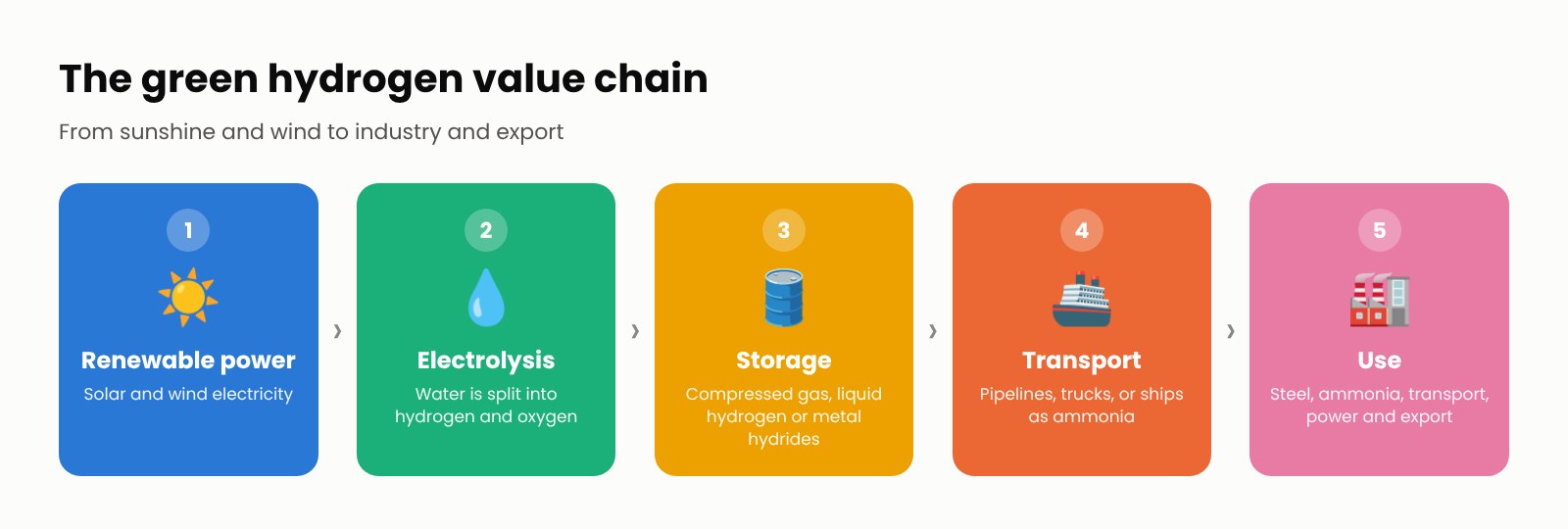
We met online on Saturday morning, my time. I asked each of them to name one thing they thought hydrogen could do. Priya said steel, Tom said cars, Liam said exports. That became our map. We drew the whole chain on a shared screen, from sunshine to electrolyser to ship, and argued happily about grey, blue and green hydrogen for most of an hour.
That night, after the house had gone quiet, I sat down and wrote it all up properly, with references, so they would have something solid to come back to. Here it is, exactly as I wrote it.
The question they brought me
Can hydrogen-powered green industries work in Australia, and what are the real opportunities and challenges?
Hydrogen has emerged as a critical energy vector in the global pursuit of decarbonisation and a sustainable energy future (Green hydrogen opportunities for emerging and developing economies, 2022). Advancements in hydrogen utilisation technologies have brought the vision of hydrogen-powered green industries closer to realisation, offering promising solutions to address climate change and energy sustainability challenges. (Green Hydrogen in Developing Countries, 2020) Hydrogen plays a pivotal role in the decarbonisation of various industries. Hydrogen can be used as a feedstock, fuel, and energy carrier, enabling the transition to a low-carbon economy. In the industrial sector, hydrogen can be used to replace fossil fuels in high-temperature processes, such as steel and cement production. Additionally, hydrogen can be integrated into existing energy systems, serving as a storage medium for renewable energy and facilitating the integration of intermittent sources like wind and solar.
Among the various green industry applications, the export of green hydrogen presents a promising opportunity for Australia. Australia’s abundant renewable energy resources, particularly in solar and wind, provide an advantage in producing cost-competitive green hydrogen (Staffell et al., 2018)(Green hydrogen opportunities for emerging and developing economies, 2022). The transportation sector is one of the most promising opportunities for Australian green hydrogen exports. Hydrogen-powered vehicles, including fuel cell electric vehicles, offer a viable solution for decarbonising the transport sector, which is a significant contributor to greenhouse gas emissions. (Staffell et al., 2018)
The Importance of Hydrogen in Decarbonization
Understanding Decarbonization
Decarbonisation refers to the process of reducing carbon dioxide (CO2) emissions associated with energy production and consumption. Industrial sectors account for a large share of global emissions. Hence it is important for large industries to choose options that helps them to transit to low-carbon alternatives as to achieve climate targets. According to the International Energy Agency (IEA), the industrial sector alone contributes to nearly 24% of global CO2 emissions, underscoring the urgency for clean energy transitions (IEA, 2020).
The decarbonisation of industries involves the adoption of cleaner energy sources, improved energy efficiency, and the implementation of innovative technologies. The basic obstacle in this process is the use of fossil fuel, which has become a traditional practice for industries. However, the fossil fuel has caused a lot of damage t the environment. This process is particularly challenging for sectors like steel, cement, and chemicals due to their dependance on fossil fuels and complex chemical processes.
Hydrogen as a Clean Energy Carrier
On the other hand when hydrogen is burned or used in fuel cells, it does not release greenhouse gases into the atmosphere, which makes it a popular choice for clean energy delivery systems. Moreover the raw material required for production of hydrogen material are available abundantly im nature including water, biomass, and natural gas
The production process, however, has a big impact on how it affects the environment. The most sustainable option is “green hydrogen,” which is created through electrolysis using energy from renewable sources like solar and wind. Hydrogen has a wide range of applications in different industries due to its versatility. It is a multipurpose fuel that can be utilized for energy storage, chemical synthesis feedstock, and transportation fuel. Moreover, hydrogen can replace fossil fuels in high-temperature industrial processes, thus contributing to the decarbonisation of sectors. Emissions are decreased, energy security is improved, and the energy supply is diversified when hydrogen is incorporated into the current industrial frameworks.
Fun fact
Hydrogen is the most abundant element in the universe: about three quarters of all ordinary matter by mass. On Earth, though, it is almost always locked up in water or hydrocarbons, so we have to spend energy to set it free.
3. Technologies Supporting Hydrogen Decarbonisation
A variety of technologies, such as hydrogen production, storage, distribution, and utilization, are necessary for the effective application of hydrogen in decarbonizing industries. Every technology is essential to guaranteeing hydrogen’s effectiveness and sustainability as a clean energy source. In this section we will discuss some of these technologies and how they play a crucial role in the transition of industries to new green energy practices
Hydrogen Production Technologies
Grey, blue, and green hydrogen are the three primary categories into which hydrogen production technologies can be broadly divided. Grey hydrogen is produced from natural gas through steam methane reforming (SMR), however this process emits significant CO2. The same procedure is used for blue hydrogen, but carbon capture and storage (CCS) is added to reduce harmful carbon emissions. On the other hand, green hydrogen is produced through electrolysis, which produces zero emissions. It uses the separation of water into hydrogen and oxygen using renewable electricity.
Every technology has benefits and drawbacks, and research is constantly being done to increase productivity, lower expenses, and scale up production. PEM electrolysis, for instance, has drawn interest due to its compact design and capacity to function at higher current densities, which makes it appropriate for decentralized hydrogen production (Gonzalez et al. 2022).
The colours of hydrogen at a glance
| Colour | How it is made | Carbon dioxide |
| Grey | Natural gas, steam methane reforming | Released into the air |
| Blue | Natural gas, with carbon capture and storage | Mostly captured |
| Green | Electrolysis of water using renewable electricity | Close to zero |
| Pink | Electrolysis using nuclear power | Close to zero |
| Turquoise | Methane pyrolysis (splitting methane with heat) | Left as solid carbon |
Try it yourself
How much water and electricity does green hydrogen take, and how much energy do you get back? Move the slider.
Hydrogen Storage Technologies
Storage is an important part of how hydrogen use can meet supply with demand. Hydrogen can be stored in multiple way in order to meet the industrial demands. Some of the common method in which hydrogen can be provided to industries are in form of compressed gas, liquefied hydrogen or as a metal hydride. The most popular of these is compressed hydrogen storage, wherein the hydrogen is stored in cylindrical tanks at high pressures. However, liquid hydrogen which is maintained in an extremely reduced temperature offers a greater energy density but comes with very tough cryogenic systems.
There is also research into emerging storage technologies, including chemical hydrogen storage (where hydrogen is stored in chemical compounds) and porous materials that may increase the efficiency and safety of storage (Moore et al.)
Hydrogen in Australia: the latest news
Since I wrote this, the hype has met reality. Several big projects have stopped, while smaller ones carry on:
Federal funding cut
In the 2026 federal budget, more than $1 billion earmarked for green hydrogen was pulled back after industry uptake fell far short of expectations.
Big projects cancelled
BP dropped its 105 MW H2Kwinana project in Western Australia in June 2026, and South Australia cancelled its Whyalla hydrogen power plant and electrolyser.
Small plants keep going
About 15 facilities in Australia produce green hydrogen today, each making between 8 kilograms and one tonne a day. Experts now expect hydrogen to matter most in ammonia and steel.
Fun fact
One kilogram of hydrogen holds about 33 kilowatt-hours of energy, nearly three times as much as a kilogram of petrol. The catch is that it is so light that storing it takes huge tanks, high pressure or very low temperatures.
Sources for the news and fun facts
The Nightly, Federal Budget 2026: green hydrogen dream gets reality check as $1.3b cut. https://thenightly.com.au/politics/federal-budget-2026-anthony-albaneses-green-hydrogen-dream-gets-reality-check-as-13b-cut-in-policy-u-turn-c-22273496
Argus Media, 24 June 2026: BP drops Australia green H2 project after fund snub. https://www.argusmedia.com/en/news-and-insights/latest-market-news/2843551-bp-drops-australia-green-h2-project-after-fund-snub
RenewEconomy: South Australia disbands Hydrogen Power office as Whyalla project officially cancelled. https://reneweconomy.com.au/south-australia-disbands-hydrogen-power-office-as-whyalla-project-officially-cancelled/amp
RenewEconomy: What’s happened to Australia’s green hydrogen dream? Five reasons the industry has floundered. https://reneweconomy.com.au/whats-happened-to-australias-green-hydrogen-dream-five-reasons-the-industry-has-floundered/amp/