 By Ahmad Bilal · November 27, 2026
Introduction to Hydrogen Storage Technologies 3
Traditional Hydrogen Storage process 3
Advantages and Disadvantages 4
Advantages and Disadvantages. 4
Advantages and Disadvantages 5
Advantages and Disadvantages 6
Emerging Hydrogen Storage Technologies 7
Advantages and Disadvantages 7
Liquid Organic Hydrogen Carriers (LOHCs) 7
Advantages and Disadvantages 8
Comparative Analysis of Hydrogen Storage Technologies 8
It rained all Wednesday, the kind of steady rain that turns a short drive into an hour. I spent the morning helping a friend sort out a solar inverter that kept shutting down, and the afternoon reading at home with a cat asleep on my notes. Around Maghrib, a message arrived with a very simple question: “Where do you actually put hydrogen?”
It came from Liam and Priya, who were studying renewable energy engineering at a university in Western Australia. They had read plenty about producing green hydrogen, but their task asked them to compare the ways of storing it, explain what each one means for Australia and pick the most promising method. “Every paper says its own method is the best,” Priya wrote.
We met online after dinner. I asked Liam to describe each method as if he were explaining it to his younger brother, and Priya to score each one on safety, cost and how much hydrogen it can hold. Compressed gas became “a scuba tank”, liquid hydrogen “a freezer you can never switch off” and metal hydrides “a sponge made of metal”. By the end, their scoring table had turned into the comparison you see below.
When the call ended I kept going, checking Australian projects and the newer carriers such as LOHCs until long after midnight. The rain had stopped by the time I finished. This is the paper I prepared for them from our discussion, word for word.
The question they brought me
What are the main methods for storing hydrogen, what are their advantages and disadvantages, how relevant are they to Australia, and which one looks most promising?
Abstract
The paper highlights various methods that are used to store hydrogen. With the increasing use of fossil fuels, the stakeholder is now constantly pushing industries to shift to a greener and eco-friendly energy resources. Although the hydrogen stands as a very promising candidate, but there are still various challenges that are hindering the supply of hydrogen due to efficient storage techniques. This study provides various advantages and disadvantages linked to present and future hydrogen storage techniques
Introduction to Hydrogen Storage Technologies
The use of fossil fuel is a traditional practice in large industries, which is easily available with a very low-cost tag. However, on the other hand, the carbon emission due to the increased use fossil fuel, has triggered a warning across the globe in form of climatic change. As a result, the policymakers and governments have shifted their focus on implementing decarbonization practices. Decarbonization refers to the process of reducing carbon dioxide (CO2) emissions associated with energy production and consumption. According to the surveys, the industrial sector alone contributes to nearly 22% of global CO2 emissions (CO2 Emissions in 2023 – Analysis, 2024).
However, this transition to shift to green energy can be very challenging to industries, especially for sectors like steel, cement, and chemicals due to their dependance on fossil fuels and complex chemical processes (Holechek et al., 2022). One of the most important candidates in this scenario that has the potential to replace the traditional fossil-based fuel is hydrogen.
Hydrogen-based fuels do not release greenhouse gases into the atmosphere when they are burned., which makes it a popular choice for clean alternative energy delivery systems. However as large number of work is being done on production of hydrogen using green processes (Hassan et al., 2024), it is also very important that proper methods should exist that can help to store hydrogen .
At present, there are a number of obstacles to overcome in the storage of hydrogen, including problems with heat-loss, energy density, and safety that require cryogenic or high-pressure environments. The following sections discusses various methods that are being used and developed for hydrogen storage.
Traditional Hydrogen Storage process
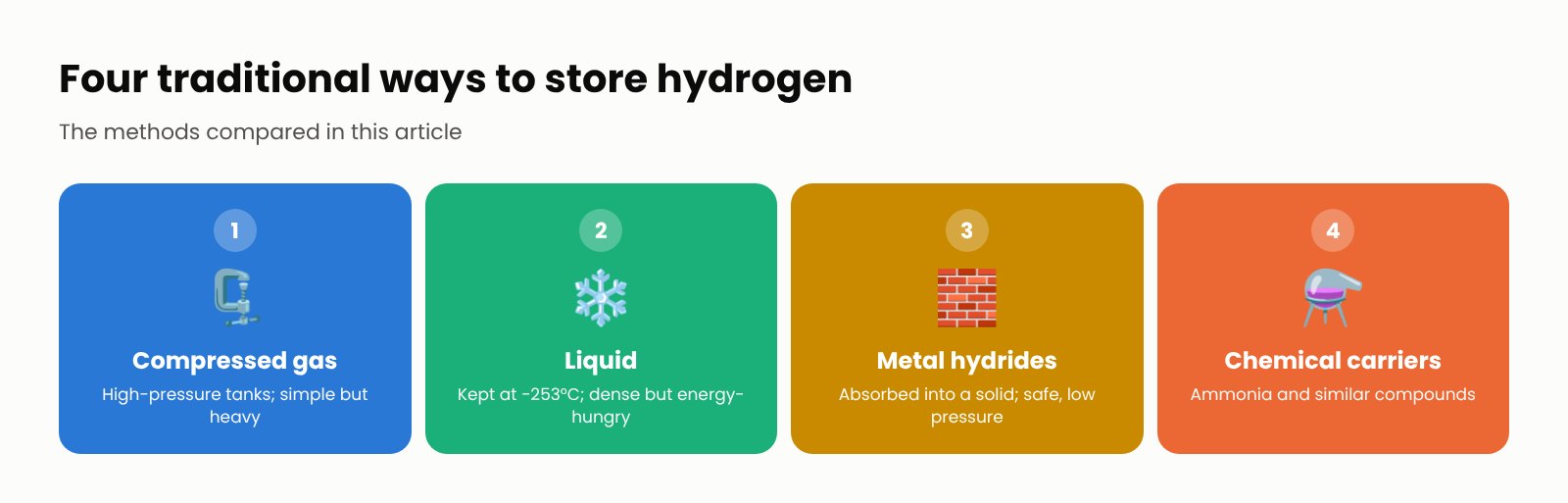
Storage is an important part of how hydrogen-based fuel can meet supply with demand. Hydrogen can be stored in multiple way in order to meet the industrial demands. This section discusses some important technologies that are used to store hydrogen-based fuels.
Fun fact
Hydrogen is so light that a single kilogram of it, at ordinary pressure and 0°C, fills about 11 cubic metres. That is roughly the inside of a small bedroom, and it is why every storage method is a fight to squeeze it smaller.
Compressed Hydrogen Gas
The compressed hydrogen gas storage has already made its way to many industrial based applications. In these methods the hydrogen gas is compressed and is then stored in specially made cylinders and tanks. These tanks are designed to withstand high pressures ranging from 350 to 700 bar (5,000 to 10,000 psi). This method is generally used in fuel cell vehicles and stationary energy storage systems (Li & Onoue, 2016)
Advantages and Disadvantages
The compressed hydrogen is considered to be the most straightforward and easy methods for hydrogen storage. The compressed gas can achieve a high energy density, which makes it a suitable candidate for applications, where space is limited. Compressed hydrogen storage systems can store around 35-40 kg/m³, which makes it an ideal candidate for automotive energy(Bouhala et al., 2024a).
On the other hand, the system poses safety risk due to the potential leaks and metal failures, which may even result in explosions. Moreover, the system needs a large amount of energy to store and compress hydrogen.
Relevance in Australia
In Australia, the automotive industry is already exploring the use of compressed hydrogen as fuel cells. The government is also investing in plans to install refueling stations that can help Australian consumers fuel up their hydrogen-based cars (Soleimani et al., 2024).
Liquid Hydrogen
Liquid hydrogen involves processes which allow us to store hydrogen gas at a very low temperature (-253°C or -423°F). Due to the low temperature, the gas converts into a liquid state. The compressed state provides higher volumetric energy density. This storage methods are particularly useful for applications that needs a large amount of energy such as aerospace or energy storage systems. Liquid hydrogen can achieve an impressive volumetric energy density of about 70 kg/m³ (Bouhala et al., 2024b).
Advantages and Disadvantages.
The liquid hydrogen can be stored in cylinders and tanks for large period of time without any particular loss, when proper conditions and insulation requirement are maintained. Similarly, when liquid hydrogen is burnt as a fuel it emits only water vapor, contributing to lower emissions.
However, on the other hand, the liquid hydrogen needs special cylinders for storage, which tends to increase the whole operations budget leading to higher costs and complexity. Similarly, special infrastructure is required to store these tanks. Moreover, during transportation, some hydrogen can evaporate as vapor due to heat transfer.
Relevance in Australia
The Australian space agency is exploring currently the liquid hydrogen as source of fuel for its new rocket propulsion research projects (Heister et al., 2022).
Metal Hydrides
Metal hydrides storage process includes the use of solid material that can absorb and release hydrogen through chemical reactions. In this process the metal hydrides are formed through the reaction of hydrogen gas and metal alloys. This process is carried out at low temperature and pressure, making it a safer and better option for hydrogen storage application. The formation of metal hydrides involves the dissociation of hydrogen molecules (H₂) into atomic hydrogen, which then interacts with the metal lattice, leading to the formation of stable hydrides. The metal hydrides obtained as a result of this process poses a high volumetric hydrogen storage capacity exceeding 100 kg/m³ (Gebretatios et al., 2024).
Advantages and Disadvantages
This process is carried out at low temperature and pressure and hence lack the risk of leaks and explosions. It is safer to be used in cars and other industries as compared to liquid hydrogen. Another advantage is the capability of hydrides to achieve high hydrogen storage densities of about 100-150 kg/m³. However, resultant hydrides can be heavy which may restrict the use of such processes in mobile applications and transpirations. Another barrier in this process is associated with the cost of the storage required of metal hydride
Chemical Hydrogen Storage
These methods involve chemical process, where hydrogen is made to react with various substances to form various stable compounds which allows efficient storage of hydrogen. Some common examples of such compounds are ammonia (NH₃) (Humphries et al., 2023). This method does not need very high maintenance condition and have a high volumetric density. Due to stability of the compound this method has a less safety threats as compared to liquid and compressed hydrogen, making it an ideal candidate for transportation. The hydrogen can be later released form these compounds by creating conduiting such as change in temperature or pressure.
Advantages and Disadvantages
Ammonia can store hydrogen at a density of 100 kg/m³, giving it a high storage density. Moreover, this method is safer for transportation and distribution purposes.
One of the main challenges linked to this process is optimizing the energy efficiency of hydrogen release processes. The release process can be very slow and researchers are concerned about the effect of other biproducts that are released to atmosphere, when hydrogen is obtained from these compounds. Furthermore, the ammonia required for creating compounds with hydrogen is linked with fossil fuel harvesting for its synthesis
Relevance in Australia
Australia is investigating ammonia as a hydrogen carrier, leveraging its existing chemical manufacturing infrastructure (Saygin et al., 2023).
The table 1 shows various comparison between the above methods discussed above
Table 1Comparison
| Hydrogen Storage Technology | Advantages | Disadvantages | Relevance in Australia |
| Compressed Hydrogen Gas | Simple technology. | Safety risks (leaks, explosions). | Used in fuel cell vehicles. |
| High energy density (35-40 kg/m³). | Energy-intensive compression process. | Government investment in refueling stations. | |
| Quick refueling. | |||
| Liquid Hydrogen | -High energy density (70 kg/m³). | Requires cryogenic infrastructure. | Investigated for rocket propulsion by the Australian Space Agency. |
| Long-term storage capability. | Possible boil-off losses. | Potential for energy storage. | |
| Emits only water vapor. | |||
| Metal Hydrides | low-pressure operation. | Can be heavy for transport. | Active research in Australia to develop lightweight and efficient hydrides. |
| High volumetric density (100-150 kg/m³). | Higher production costs. | ||
| Safer than gas/liquid forms. | |||
| Chemical Hydrogen Storage | High energy density (e.g., ammonia: 100 kg/m³). | Complex hydrogen release processes. | Exploring ammonia as a hydrogen carrier in chemical manufacturing. |
| Stable at ambient conditions. | Environmental concerns from by-products. |
Try it yourself
Try it yourself. Choose an amount of hydrogen and compare how much room each method needs to hold it.
Emerging Hydrogen Storage Technologies
In addition to well-established hydrogen storage methods, several emerging technologies are being developed to enhance hydrogen storage capabilities. This section explores some of these approaches and methods
Advanced Metal Hydrides
In tradition metal hydrides, light weigh metal alloys are used, in order to replace the heavy weight metal alloys used in traditional process. These advances hydrides have the potential to store more hydrogen. These materials include lightweight alloys and nanostructured hydrides, that not only have more higher absorption efficiency but also better release kinetics (Negro et al., 2023).
Advantages and Disadvantages
This method provides a high capability of storing hydrogen and faster kinetics to release the fuel. Furthermore, the use of light alloys result in a lighter output product that is easy to handle and more suitable for transportation However, this method has yet not reached the maturity and is still under the research phase. Moreover, the new alloys can be expensive, which can result in significant investment
Liquid Organic Hydrogen Carriers (LOHCs)
These are organic compounds that can organically react with hydrogen and have the capability to store them. These compounds can release hydrogen under controlled conditions like heating or presence of a particular catalytic processes(Le et al., 2024). In general, these compounds are stable and are nonflammable, which make this approach safer than others.
Advantages and Disadvantages
LOHCs are stable and nonflammable, which makes it an ideal candidate for transportation and replacing it with existing liquid fuel. However, in order to obtain hydrogen from LOHCs, additional elements can be required, which may overall impact the cost and overall efficiency. The process is still under research phase, and needs more maturity before it can be labelled for industrial use
Comparative Analysis of Hydrogen Storage Technologies
A comparative analysis of the technologies can help us to highlight the relative strength and weakness of each technology. We will carry out analysis based on four key dimensions efficiency and capacity, safety and stability, cost-effectiveness, and environmental impact.
Table 2 Comparison
| Dimension | Compressed Hydrogen Gas | Liquid Hydrogen | Metal Hydrides | Chemical Hydrogen Storage |
| Energy Density | 35-40 kg/m³. (Rank: 4) | ~70 kg/m³. (Rank: 3) | 100-150 kg/m³. (Rank: 1) | ~100 kg/m³ (e.g., ammonia). (Rank: 2) |
| Efficiency and Capacity | Moderate efficiency. (Rank: 3) | High energy density enhances long-term storage capabilities. (Rank: 1) | High absorption/release efficiency at low pressures. (Rank: 2) | Energy efficiency varies; dependent on release processes. (Rank: 4) |
| Safety and Stability | High-pressure risks (leaks, explosions). (Rank: 3) | Requires special handling to avoid cryogenic hazards. | Operates at lower pressures, safer than gas/liquid storage. | Stable and less risky during storage; ambient conditions are safe. (Rank: 1) |
| Risk of boil-off losses. (Rank: 2) | Stable under normal conditions. (Rank: 1) | |||
| Cost-Effectiveness | Established infrastructure reduces costs. (Rank: 2) | High initial costs for cryogenic systems; significant operational costs. (Rank: 4) | Initial costs can be high due to materials. Research may reduce future costs. (Rank: 3) | Lower transport costs; concerns about fossil fuel-based synthesis. (Rank: 1) |
| Environmental Impact | Fossil fuel reliance for compression. (Rank: 4) | Minimal emissions during use; energy input impacts carbon footprint. (Rank: 2) | Lower emissions if sourced sustainably; material production may impact environment. (Rank: 1) | Low emissions potential with sustainable practices; environmental concerns about by-products. (Rank: 3) |
| Potential emissions from leaks. | ||||
| Relevance to Australia | Used in automotive fuel cells; investment in refueling stations. (Rank: 2) | Explored by the Australian Space Agency for rocket propulsion. (Rank: 1) | Ongoing research in Australian universities to enhance lightweight hydrides. (Rank: 3) | Investigating ammonia as a hydrogen carrier; leveraging chemical manufacturing expertise. (Rank: 2) |
The comparative analysis of hydrogen storage technologies highlights strengths and weaknesses across key dimensions: energy density, efficiency and capacity, safety and stability, cost-effectiveness, environmental impact. Metal hydrides ranks as the leading option in terms of energy density, achieving impressive volumetric storage capacities of 100-150 kg/m³, followed by chemical hydrogen storage with around 100 kg/m³.
Liquid hydrogen, is most suitable for its long-term storage capabilities, but it ranks lower due to the complexity and costs associated with cryogenic systems. Compressed hydrogen gas, have established infrastructure, but has safety concerns linked to high-pressure systems. In terms of safety and stability, chemical hydrogen storage is the safest option.
Most Promising Method
In my view the metal hydrides have the potential as most promising storage method, as it has impressive volumetric hydrogen storage capacity, safety, and efficiency. It has the ability to store between 100 to 150 kg/m³ of hydrogen. Furthermore, the metal hydrides do not require the specific setup of pressure and temperature maintenance. This safety feature makes it suitable for industrial use and residential applications. Furthermore, they have high absorption rate at low temperatures, makes them ideal candidate for hydrogen cell fuel vehicle.
The versatility of metal hydrides further allows them to be used in wide range of applications. As the research continues, the use of lightweight alloys is expected to further increase the hydrogen absorption process while reducing the weight of alloys.
Conclusion and Way Forward
The transition from fossil fuel to green energies such as hydrogen has become a necessity in order tackle the increasing impact of climate change. This shift would enable the industries to practice such methods that would help to reduce the carbon foot print. The essay highlights the various hydrogen storage methods and analyses their advantage and disadvantages compressed hydrogen gas, liquid hydrogen, metal hydrides, and chemical hydrogen storage. Each of these methods have their own advantages and are suitable for different applications. During analysis it was found that metal hydrides have the potential to stand out as a promising contender to replace tradition fossil fuels. With a capacity of 100 to 150 kg/m³, they offer an attractive alternative for both industrial and residential applications, especially as research continues to enhance their performance and reduce costs.
In order to maximize the efficiency of these hydrogen storage methods, it is essential to foster collaboration between researchers, governments and industries. Furthermore, policy makers need to draft such policies that would provide initiative to industries that are shifting their approach towards hydrogen-based fuels. These methods can help all sectors to pave a clear path for cleaner and more resilient energy landscape that meets the energy demands
Hydrogen storage in Australia: the latest
Since this paper was written, Australia has mapped where it could store hydrogen underground, and the industry has had a reality check:
5 million tonnes of storage
CSIRO estimates a fully developed hydrogen industry would need around 5 million tonnes of storage capacity. It calls salt caverns the most ready option and depleted gas fields the most promising and widely available in Australia.
Fewer projects, more building
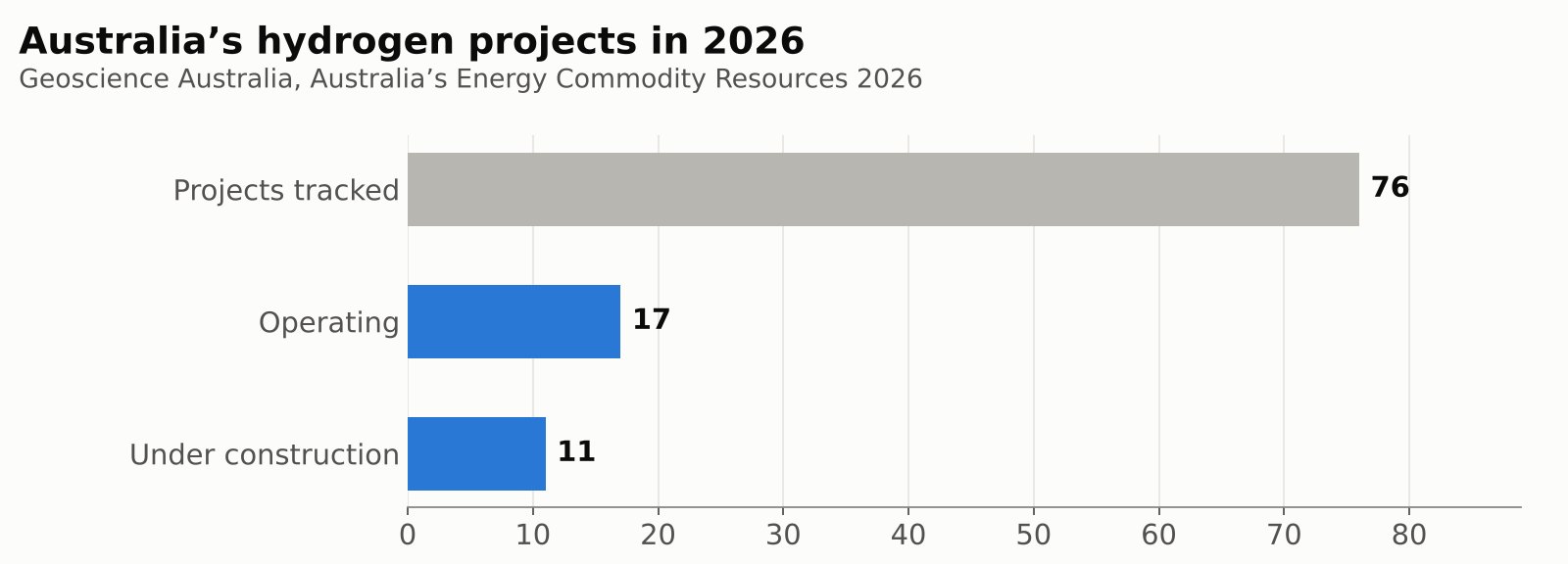
Geoscience Australia’s 2026 review counts 76 announced hydrogen projects, down from 90 in 2024. Of these, 17 are operating and 11 are under construction.
Salt in the right places
The same review names the Adavale, Amadeus, Polda and Bonaparte basins as places with salt that could host underground storage caverns.
Underground storage options in Australia
| Option | How ready is it? | Why it matters |
| Salt caverns | The most ready technology | Salt walls are tight, so hydrogen stays in; caverns can fill and empty quickly |
| Depleted gas fields | Likely the most promising in Australia | Widely available and need less initial investment |
| Saline aquifers | Still being studied | Large volumes, but less is known about how hydrogen behaves there |
References
Bouhala, L., Karatrantos, A., Reinhardt, H., Schramm, N., Akin, B., Rauscher, A., Mauersberger, A., Taşkıran, S. T., Ulaşlı, M. E., Aktaş, E., & Tanoglu, M. (2024a). Advancement in the Modeling and Design of Composite Pressure Vessels for Hydrogen Storage: A Comprehensive Review. Journal of Composites Science, 8(9), Article 9. https://doi.org/10.3390/jcs8090339
Bouhala, L., Karatrantos, A., Reinhardt, H., Schramm, N., Akin, B., Rauscher, A., Mauersberger, A., Taşkıran, S. T., Ulaşlı, M. E., Aktaş, E., & Tanoglu, M. (2024b). Advancement in the Modeling and Design of Composite Pressure Vessels for Hydrogen Storage: A Comprehensive Review. Journal of Composites Science, 8(9), Article 9. https://doi.org/10.3390/jcs8090339
CO2 Emissions in 2023 – Analysis. (2024, March 1). IEA. https://www.iea.org/reports/co2-emissions-in-2023
Gebretatios, A. G., Banat, F., & Cheng, C. K. (2024). A comprehensive review of hydrogen storage: Toward nanoconfinement-enhanced borohydride and alanate complex hydrides. Sustainable Energy & Fuels. https://doi.org/10.1039/D4SE00353E
Hassan, Q., Algburi, S., Sameen, A. Z., Salman, H. M., & Jaszczur, M. (2024). Green hydrogen: A pathway to a sustainable energy future. International Journal of Hydrogen Energy, 50, 310–333. https://doi.org/10.1016/j.ijhydene.2023.08.321
Heister, S. D., Smallwood, J., Harroun, A., Dille, K., Martinez, A., & Ballintyn, N. (2022). Rotating Detonation Combustion for Advanced Liquid Propellant Space Engines. Aerospace, 9(10), Article 10. https://doi.org/10.3390/aerospace9100581
Holechek, J. L., Geli, H. M. E., Sawalhah, M. N., & Valdez, R. (2022). A Global Assessment: Can Renewable Energy Replace Fossil Fuels by 2050? Sustainability, 14(8), Article 8. https://doi.org/10.3390/su14084792
Humphries, T. D., Buckley, C. E., Paskevicius, M., & Jensen, T. R. (2023). State-of-the-Art and Progress in Metal-Hydrogen Systems. Inorganics, 11(12), Article 12. https://doi.org/10.3390/inorganics11120476
Le, T.-H., Tran, N., & Lee, H.-J. (2024). Development of Liquid Organic Hydrogen Carriers for Hydrogen Storage and Transport. International Journal of Molecular Sciences, 25(2), Article 2. https://doi.org/10.3390/ijms25021359
Li, H.-W., & Onoue, K. (2016). Compressed Hydrogen: High-Pressure Hydrogen Tanks. In K. Sasaki, H.-W. Li, A. Hayashi, J. Yamabe, T. Ogura, & S. M. Lyth (Eds.), Hydrogen Energy Engineering: A Japanese Perspective (pp. 273–278). Springer Japan. https://doi.org/10.1007/978-4-431-56042-5_19
Negro, V., Noussan, M., & Chiaramonti, D. (2023). The Potential Role of Ammonia for Hydrogen Storage and Transport: A Critical Review of Challenges and Opportunities. Energies, 16(17), Article 17. https://doi.org/10.3390/en16176192
Saygin, D., Blanco, H., Boshell, F., Cordonnier, J., Rouwenhorst, K., Lathwal, P., & Gielen, D. (2023). Ammonia Production from Clean Hydrogen and the Implications for Global Natural Gas Demand. Sustainability, 15(2), Article 2. https://doi.org/10.3390/su15021623
Soleimani, A., Hosseini Dolatabadi, S. H., Heidari, M., Pinnarelli, A., Mehdizadeh Khorrami, B., Luo, Y., Vizza, P., & Brusco, G. (2024). Progress in hydrogen fuel cell vehicles and up-and-coming technologies for eco-friendly transportation: An international assessment. Multiscale and Multidisciplinary Modeling, Experiments and Design, 7(4), 3153–3172. https://doi.org/10.1007/s41939-024-00482-8
Sources for the news and fun facts
CSIRO: Underground hydrogen storage (storage need and readiness of each option). https://www.csiro.au/en/research/technology-space/energy/Electricity-transition/Energy-storage/Underground-hydrogen-storage
Geoscience Australia: Australia’s Energy Commodity Resources 2026, Hydrogen (project counts and salt basins). https://www.ga.gov.au/aecr2026/hydrogen
Fun fact worked out from the ideal gas law: one mole of gas fills 22.4 litres at 0°C and 1 atmosphere, and 1 kg of hydrogen is about 496 moles.